


Description
---------------------------
Choosing Big Things for this suite was even harder than for the NSW version, as Queenslanders embraced the Big Things phenomenon to a whole new level. In some cases one example of a big thing wasn't enough - with several duplicate examples existing (including barramundi, crocodile, peanut, pumpkin, orange, and apple) - and oh so, SO much fruit! Quite a lot of folks also came to me with suggestions. Unfortunately, a work comprising dozens of big things wasn't going to be practical. Also, I needed a musically balanced suite, and some big things were going to be tricker for me to come up with a musical concept for than others. So, with a whole range of things in mind, including keeping with the style and intent of Postcards from Big Things NSW, the following five Queensland Big Things made the cut!
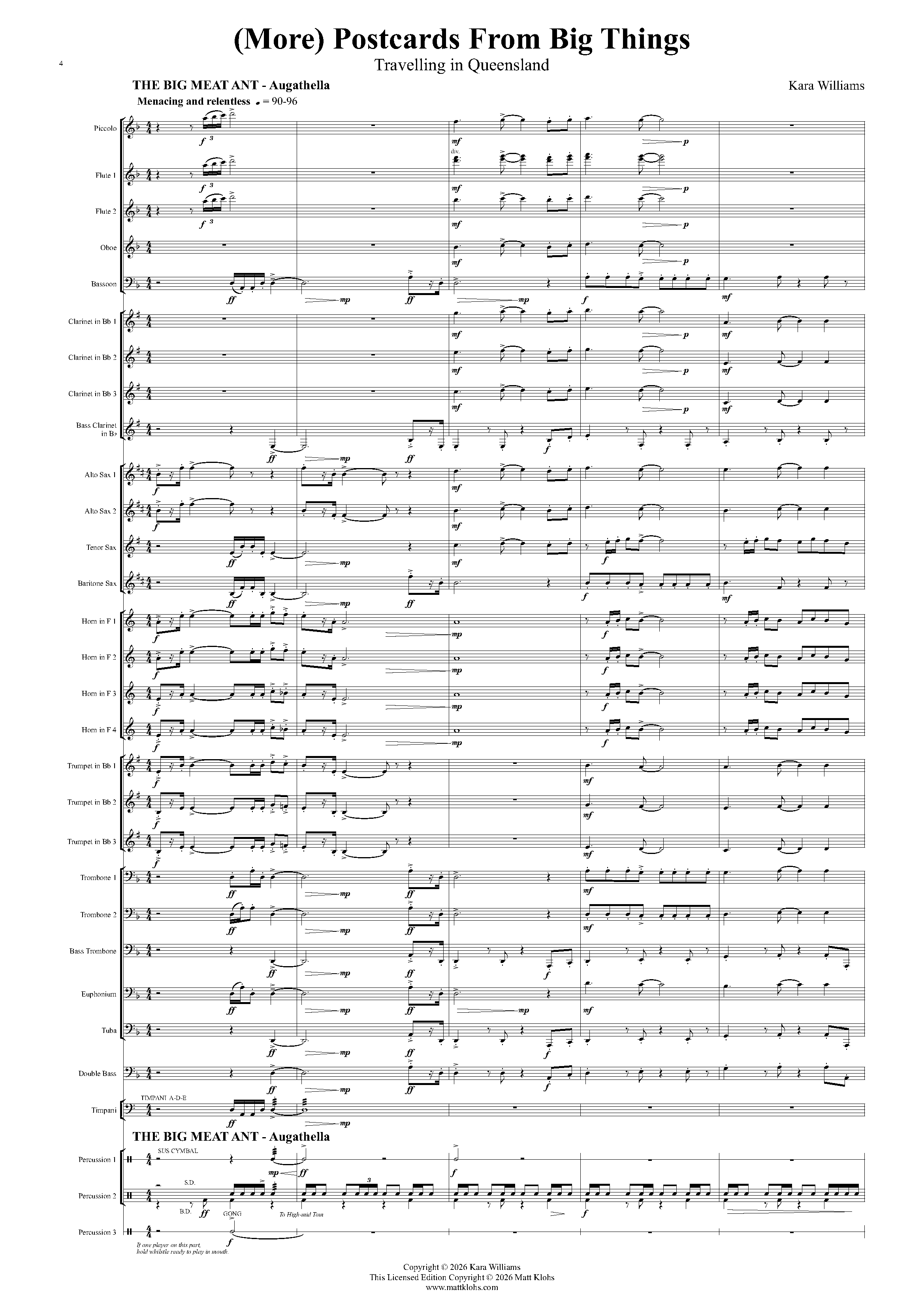
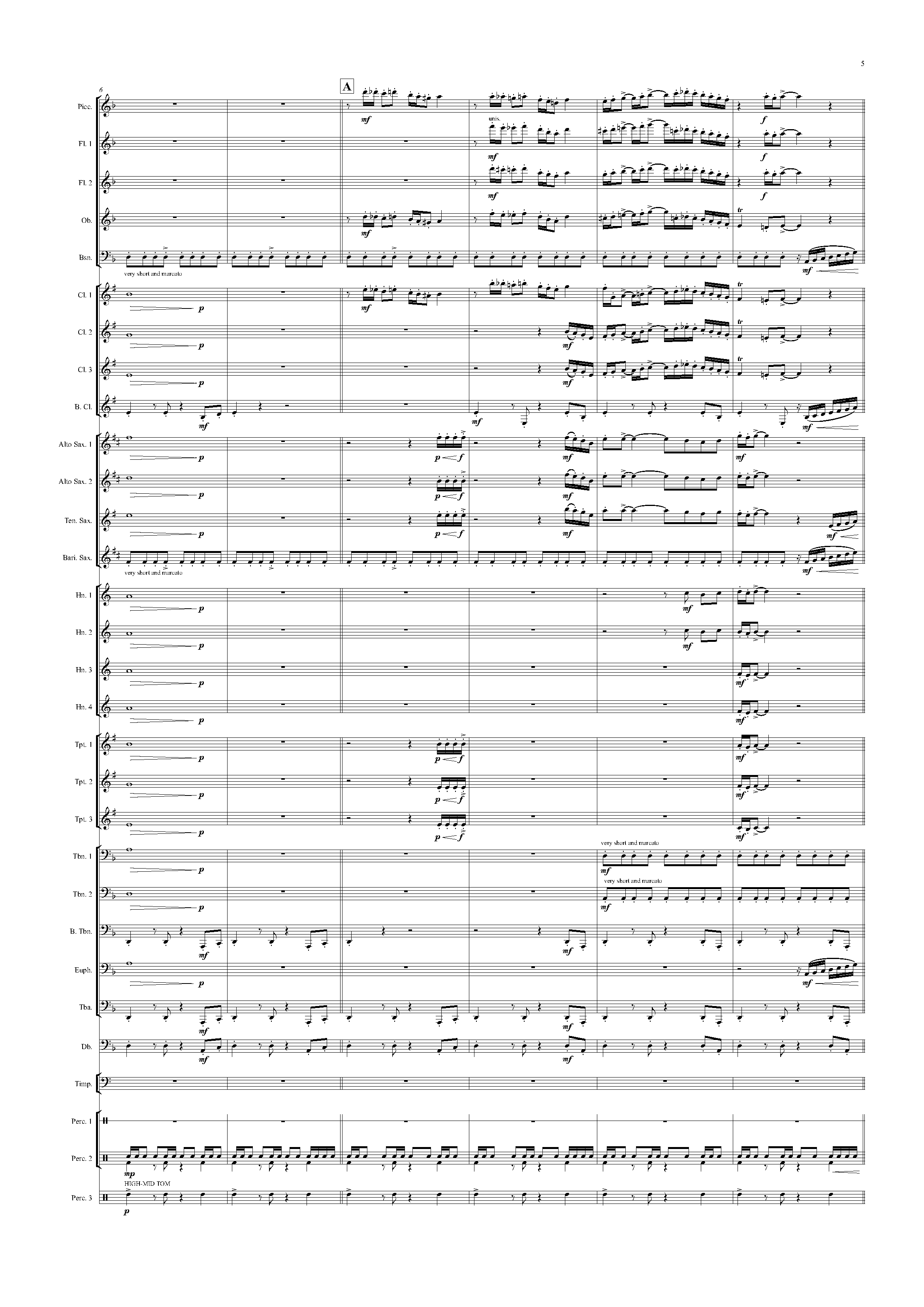
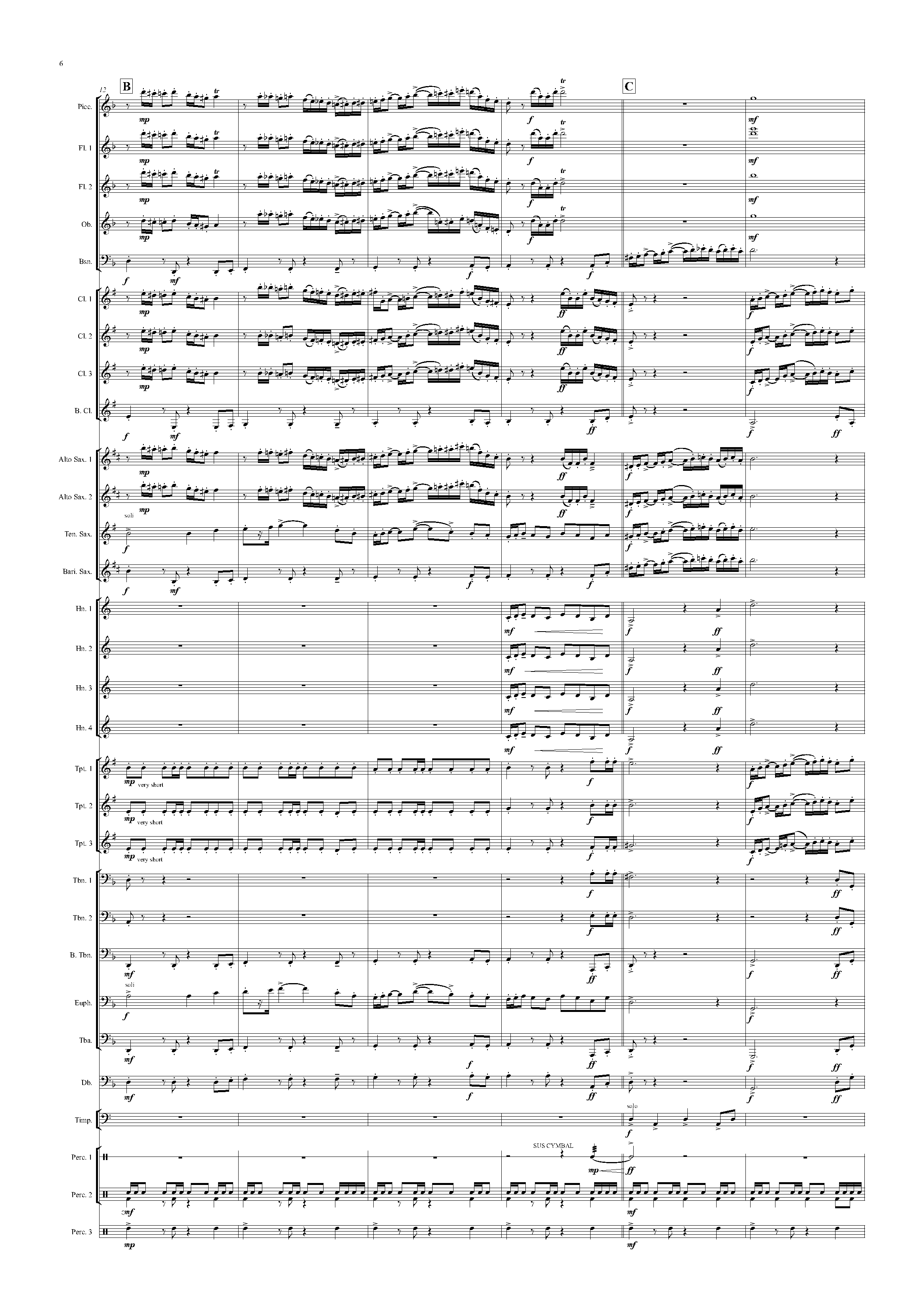
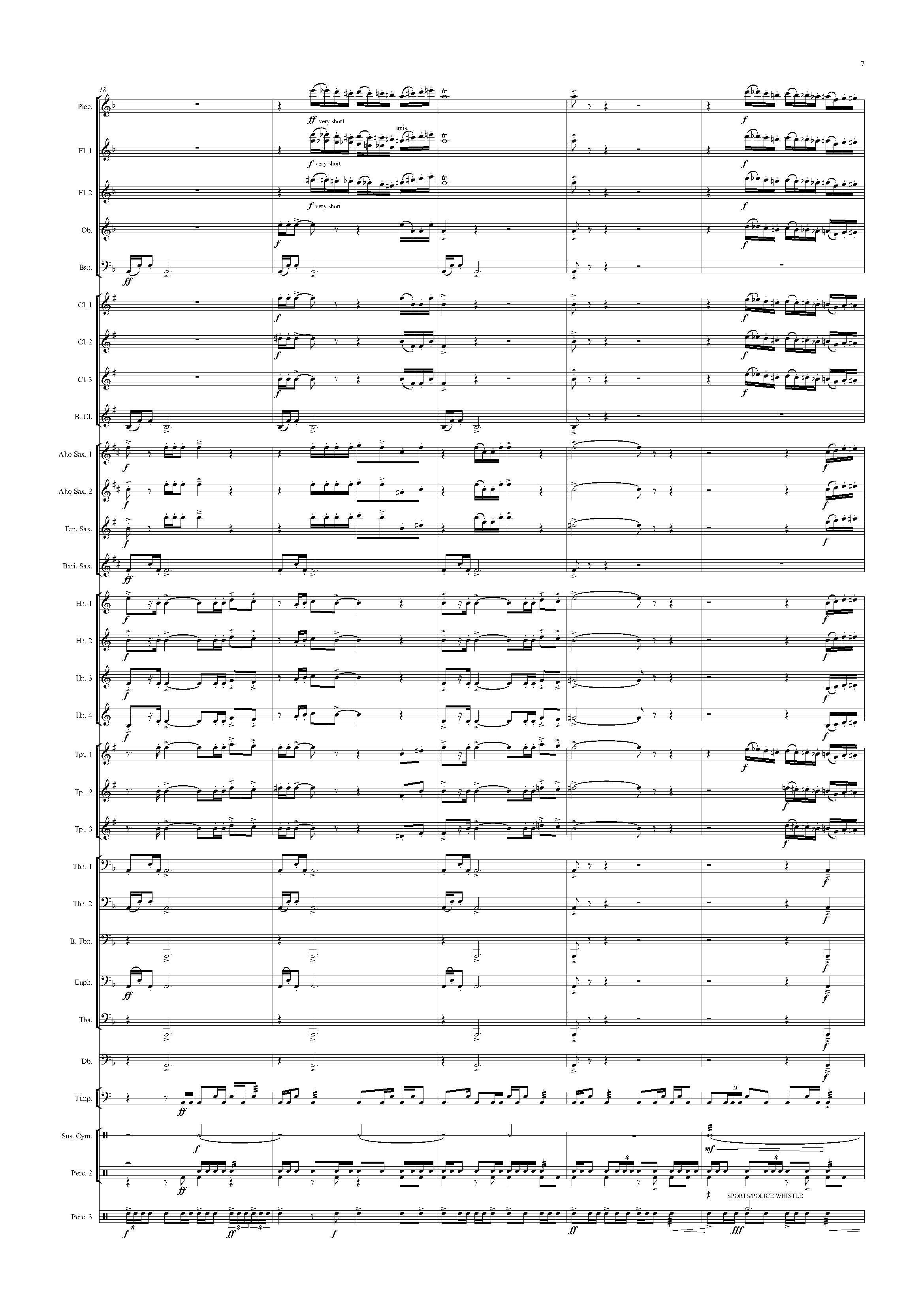
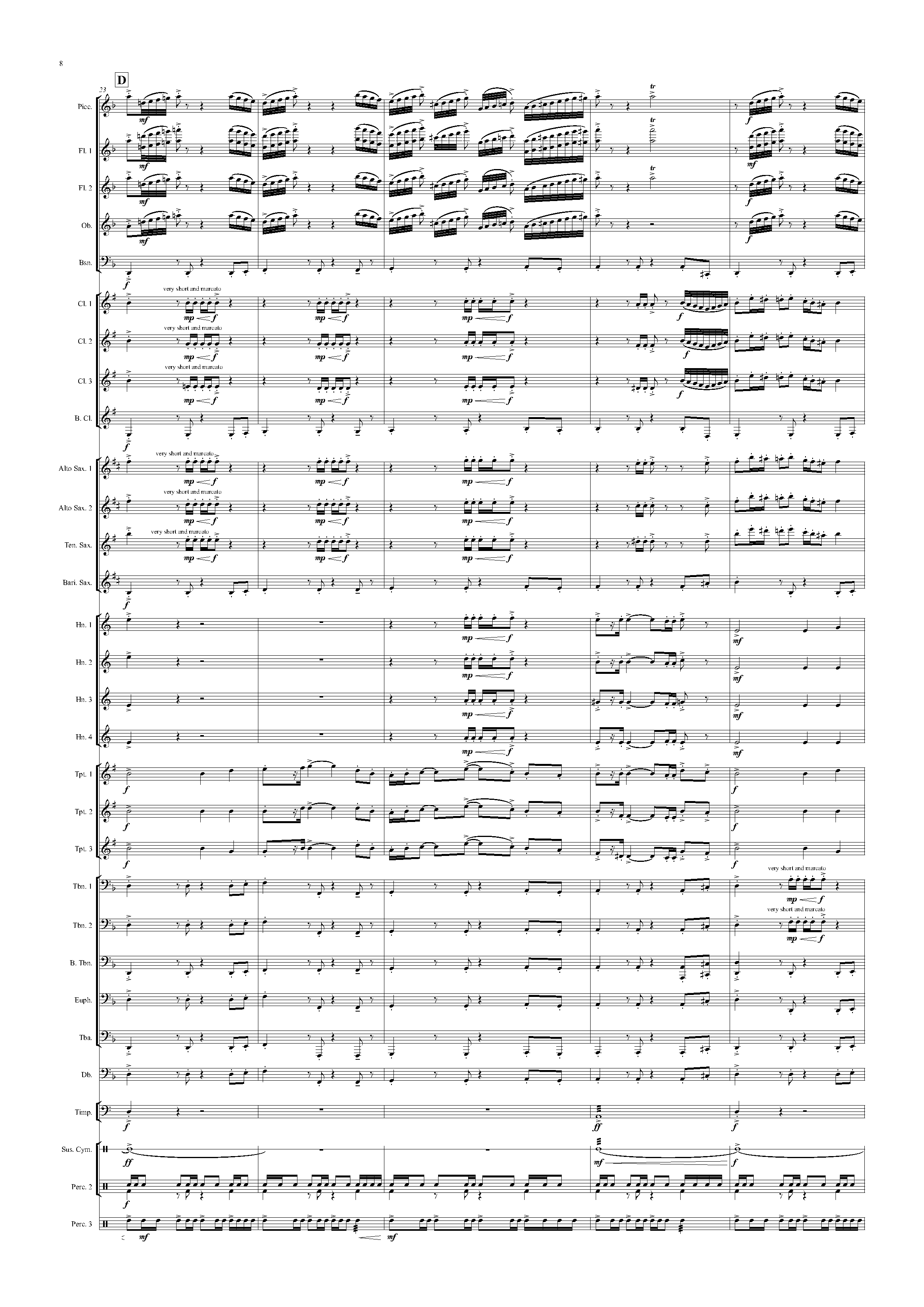
THE BIG MEAT ANT – Augathella (2011) This intimidating 5m tall wood, brass, copper, and steel structure was commissioned by the Murweh Shire in the hope of attracting tourists. The menacing looking meat ant hangs upside down on its telegraph pole eying off passers by in the aptly named ‘Meat Ant Park’. The meat ant is the mascot of the township of Augathella not because the town is overly populated by the aggressive little insects, but instead honours the 1960s hey-day of the local junior football team, the Mighty Meat Ants, who apparently played with great 'tenacity' wearing a maroon and blue uniform evocative of the meat ant. Unfortunately there is no longer a junior league in the area; however, the legend of the small but mighty Meat Ants lives on. Through a gladiatorial and sport anthem lens this postcard featuring a darker fanfare-style march to convey both a relentless army of meat ants and their name-sake sports team going in to 'battle' on the field. Build the tension right up to the major suspended chord (triumph of course!) and make a big deal of the sports whistle in the percussion battle. Focus on accents and detachment for style and clarity.
THE BIG SAPPHIRE – Anakie (1982) The Big Sapphire waits patiently out the front of the local Caravan Park at Anakie in the Central Highlands Gemfields area (after the closure of the Tourist Information centre). A mystery for many years, the creator of the Big Sapphire returned to Anakie to visit his 3.7m x 2.26m representation now updated in eye-catchingly incandescent blues and purples. Less flamboyant than the diamond or ruby, the sapphire exudes an understated old-world class and elegance. Taking inspiration from Ellington & Bigard’s famous jazz standard ‘Mood Indigo’, Sapphire’s uncomplicated melody and beguiling ‘blue’ harmony is complemented by an interwoven sparkle of percussion and upper woodwind: glinting as the light dances off the gemstone’s facets. Slightly simplified for this grading, this original form of Sapphire inspired the composer's stand-alone award-winning Grade 5 wind ensemble work of the same name. The oboe, piccolo and horn should be the dominant voices at the start and finish. Keep this work steady and spacious where it moves from the 4 feel into the 2 feel (l'istesso), lean into the woodwind passages soloistically, and be confident with the tutti chords just before the end.
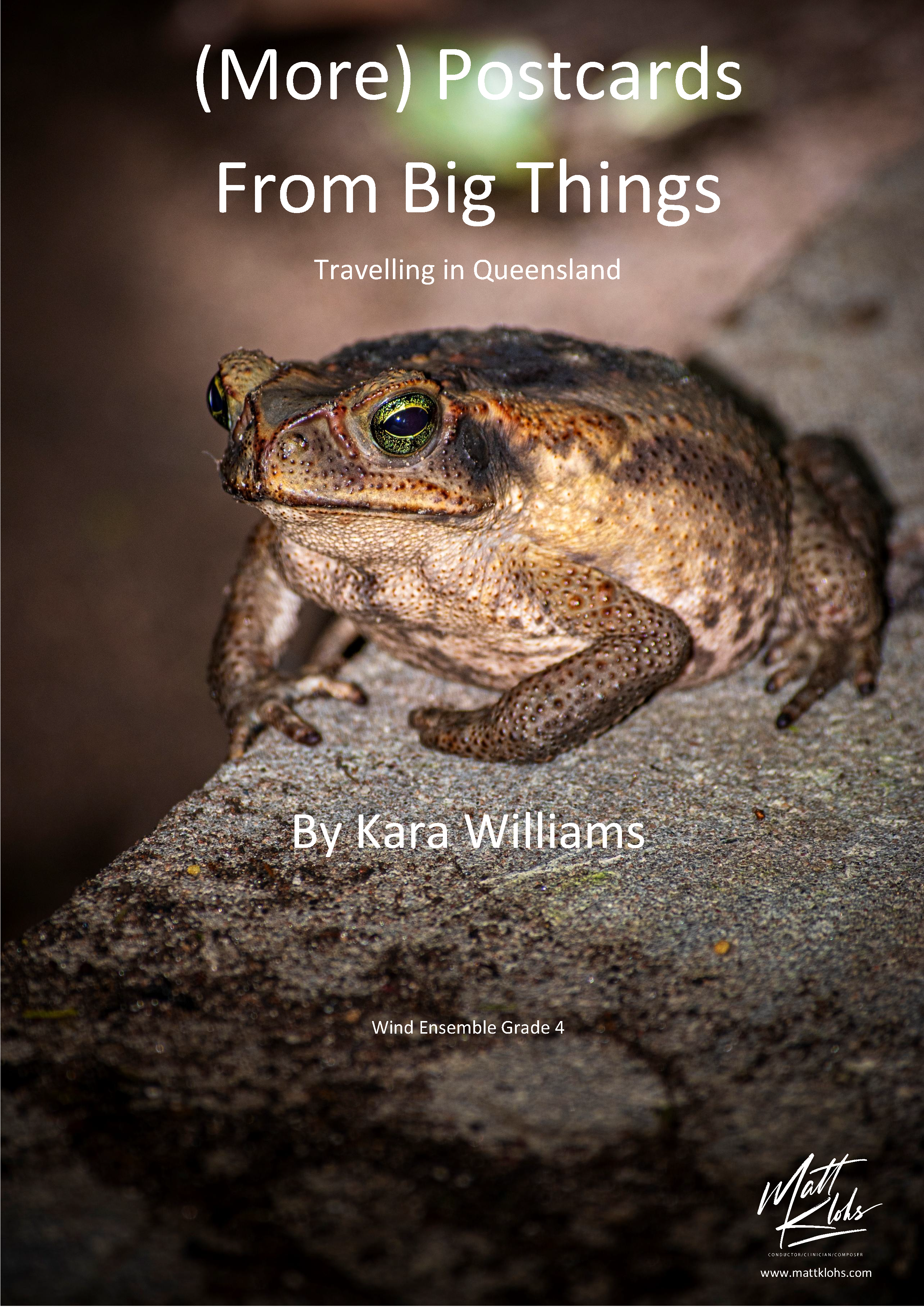
THE BIG CANE TOAD – Sarina (1983) After its scientific name Bufo Marinus, ‘Buffy’ the 4m x 1m fibreglass cane toad started life as papier-mâché character on the back of a 1983 Sugar Festival float through the town of Sarina - around 35km South of Mackay. Controversially celebrating one of Australia’s most environmentally aggressive and damaging introduced species, cane toads have become an inescapable feature of life in Queensland. Their unusual deep rattly calls (represented by the vibra slap and marimba) herald their ubiqitously nasty presence hidden away under leaf litter and in cracks and crevices. Even the National Rugby League (NRL) Queensland State of Origin Team wear the toad as a badge of honour! In Sarina, Buffy can often be seen draped in the ubiquitous maroon and gold football colours. Having been stolen several times, the toad-proud community was prompted to bolt Buffy to a concrete slab! Slimy and toxic, this postcard toad leaps to the demise of your choosing with an unceremonious thud at the end of this postcard. Ensure straight quavers throughout. Have fun with the crescendo decrescendo figures and glissandi, and bring out the "Mars"-esque section as Queenslanders wage war on the insidious and destructive pint-sized lumpy brown invaders.
THE BIG DUGONG - Rockhampton (1992) Housing the Aboriginal and Torres Strait Island Dreamtime Cultural Centre in Rockhampton on the lands now protected by the local indigenous Mutawintii people, this enormous sculpture is 22m long, 5m, high and 12m wide and is constructed with fibreglass and concrete over a steel frame. A fairly recent addition to the collection of Australian Big Things, the Big Dugong weighs significantly more than its dolphin-sized namesake! More closely related to elephants, the dugong is one of only four in its species order (which also includes three species of manatees). Slowly and gracefully, the dugong grazes sea grass in the shallow waters throughout the Indo-West Pacific. It is an important part of local indigenous culture and along with its manatee cousins, has been a popular mythological animal often considered the inspiration for mermaids. Serene and flowing, weightlessly float through sunny tropical aquatic pastures.
THE BIG PINEAPPLE – Woombye (1971) Built to rival the very popular New South Wales Big Things, Queensland was at one time home to two Big Pineapples that were both opened in 1971, were both 16m tall, and were in fierce competition with each another. Gympie lost the race, and their Big Pineapple was demolished in 2008 due to a redevelopment of the site. Now the State’s oldest surviving Big Thing, the Big Pineapple just off the Bruce Highway in Woombye (South of Nambour on the Sunshine Coast) has now been Heritage Listed and thanks to the pineapple water tower in Hawai’i being pulled down, the Woombye Pineapple has also now claimed the title of the ‘World’s Biggest’. Not without its own dramas, Woombye’s Pineapple was torched in an attempted robbery in 1978, in 1991 a tornado destroyed the Pineapple’s top, and in 2009 the complex went into receivership and was sold to a development company in 2011. Thankfully, the resurgence in Big Things popularity has meant Woombye’s iconic Big Pineapple has now re-opened and is more beautifully yellow and spikey than ever! A pineapple 'salsa' - what else could it be?! Using the key salsa elements of a 2-3 montuno (a two bar repeating clave beat and arpeggio accompaniment pattern), salsa percussion instruments and rhythms, call and response melodic figures, horn solos, and a tumbao (syncopated bass line). A major salsa chord progression creates a sountrack evocative of those slightly cheesy retro 'relaxed fun in sun' postcards and is a joyous way to finish off the second of the two Postcards from Big Things suites. The magic in this movement happens in the dynamic and articulation contrast. Basses will likely need reminding to anticipate the anacrusis runs so they don't drag and also across the centre syncopation of the two-bar tumbao because it does not rhythmically align with the clave/montuno at this point (slight separation and sense of bounce in this line will also help). Conversely, upper instrument will have a tendency to rush. Playing with lightness and a focus on the pulse - especially the anchor point at each two bar cycle - will help the layered melodic figures, clave, montuno, and tumbao grooves line up with security and clarity.
INSTRUMENTATION: Piccolo, Flute 1 2, Oboe, Bassoon, Bb Clarinet 1 2 3, Bb Bass Clarinet, Alto Saxophone 1 2, Tenor Saxophone, Baritone Saxophone, F Horn 1 2 3 4, Bb Trumpet 1 2 3, Trombone 1 2, Bass Trombone, Euphonium (BC & TC), Tuba, Double Bass, Percussion I - IV
Percussion I part: Timpani, Triangle*, Timbales (high/low)
Percussion II part: Suspended Cymbal (standard)*, Glockenspiel, Marimba, Bongo Drums (bongos using drum sticks)
Percussion III part: (incorporates drum kit), Shaker (or Hi Hat), Ride Cymbal (suspended), Suspended Cymbal (standard/crash), Medium or High Tom-Tom, Low Woodblock (mounted), Snare Drum, Bass Drum (kick drum can be used), High/Low, Conga drums (can use drum kit med-low toms instead), Vibraphone
Percussion IV part: Gong, High-Medium pitched drum (tom tom), Sports/Police Style Pea Whistle, Wind Chimes, Vibraslap, Ratchet, Tambourine, Triangle* Suspended Cymbal (standard)*, Claves
*One triangle and one suspended cymbal can be shared between these parts as they are performed by different players at different times in different movements.